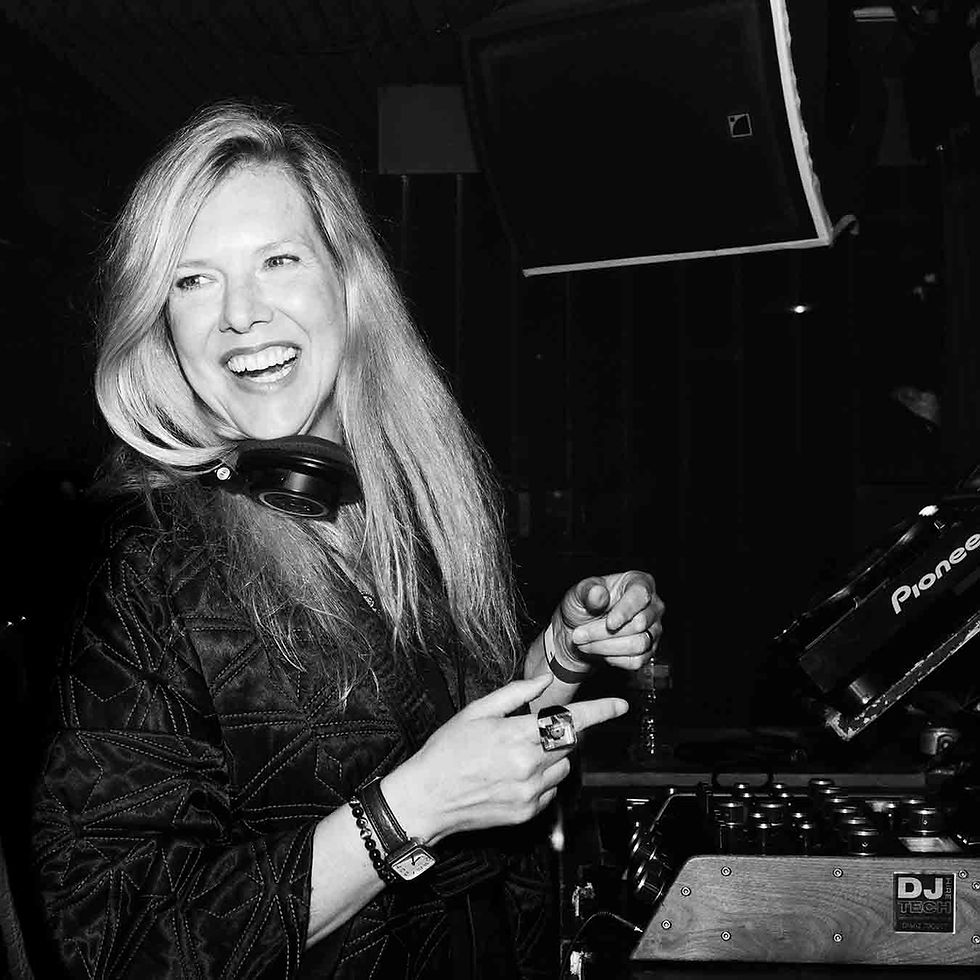
Heléna Star in conversation with Colleen 'Cosmo' Murphy
Updated: Jul 3
Ahead of their New Year’s Eve party, Heléna Star sat down with Colleen Cosmo Murphy for a fascinating chat in the Voices Studio.

THE INTERVIEW
[Heléna]
Okay, Colleen, thank you so much for joining me.
[Colleen]
Oh, thank you. Thanks for having me.
[Heléna]
Um, I feel like we've just been having a little chat off air, but getting to know each other. This is actually our first time probably meeting.
[Colleen]
Absolutely. And we're playing together on New Year's Eve. So that'll be great.
[Heléna]
In the building that we're in right now!
[Colleen]
Which is great to do a site visit before I arrive, which is amazing.
[Heléna]
I know you were already plotting out where the speakers are going to go and how it's going to sound. We're looking at the carpet. I guess that's a really good place to start. I feel like your knowledge of audio and sound is rich. Deep. Can you tell us about, actually, do you know what? Tell us about the first rig that you remember learning about that really like caught your attention or that you were like, whoa, yeah, special.
[Colleen]
Well, the first sound system that really impressed me was my friend David Mancuso's sound system from the loft. And I had already studied sound in university. I was a radio and sound major, but it was on the recording side. So it was mixing techniques, microphone placement, editing. It was all tape back then in the 1980s. So it was editing tape, but it wasn't about reproducing music. It wasn't about playback. So it wasn't about speaker positions or amplifiers and the different types of amplifiers and/or cartridges, for instance, the different styli that you can use for turntables, moving magnet or moving coil.
And it was really going to my friend David Mancuso's loft parties. And first of all, just experiencing the sound as a dancer and really thinking, gosh, it's just kind of washing over me. I don't hear the sound system. I hear the music.
[Heléna]
That's interesting.
[Colleen]
And it's because he was using these beautiful Klipschorn speakers, which are three-way, horn speakers. And horn speakers are really efficient, very natural sounding. And then class A amplifiers and these beautiful moving-coil cartridges made by Kuetsu, handcrafted in Japan. Thousands of dollars each.
[Heléna]
So this is back then.
[Colleen]
Yeah, this is back then. This is David's system. This is the system that this is the loft style sound system. It's the same type of system we have here in London for our London loft parties. And I didn't know what all of these things were. I just knew when I went in, wow, this sounds so different. Every song sounds incredible. Even really kind of basic house tracks. And this is like 1992. This is early house.
And, you know, something that you didn't hear the nuance on a regular system or regular DJ cartridges, which are usually quite blunt and very heavy. Lots of bass. Everything sparkled. It had a lot of dynamic.
And I wouldn't have learned any more about it unless he had asked me. Then a few couple of years later, or maybe a year later, I can't remember exactly. He asked me to play some one-on-ones with him. And all of a sudden, I knew that I had to use the Koetsu. And the Koetsu moving coil cartridge, he only had two. He was really down on money. He was really suffering. And if one broke, he was out of commission because he wouldn't be able to fix it. He wouldn't have the money to send it back to Japan, get it repaired. So and everyone talked about this. There is no backup cartridge.
And so he taught, and it's all you can't back cue.
[Heléna]
Okay.
[Colleen]
And there's no headphones because it's on a DJ mixer. It's a preamp made by Mark Levinson, a classic preamp. It's actually a cult classic. It's called an ML1, but it has two phono stages. So it has one phono input and two phono inputs. You just click back and forth.
You play the whole song and then click to phono back and forth. So there's no way to even preview the songs. So you had to use by eye. Luckily, in my early 20s, I have fabulous eyesight, which I no longer have. And I remember my first cut that I played was an inside cut. It wasn't even an outside cut.
You had to know which speed it was because you can't preview it. So everything has to be marked. Number two, 33, cold fade, fade out, whatever, cold ending or whatever it is, which we used to do with radio as well, quite honestly, back in the day, because you'd sticker things up. Yeah. Because everything was going so fast.
[Heléna]
I quite like that.
[Colleen]
Yeah, it was all stickered up. Yeah. So that's what I had to do. You said, rest your hand, cue it like this. And so first it was just basic techniques of like how to just play records. But then when we started the parties here in London, he wanted me to handle the music and the sound with him.
And so I just learned A to Z, you know, the whole loft setups for starting the turntables and amplifiers setup, speaker setup. So it's really through David that I learned a lot. But I've also learned a lot through my friend Ian Mackie, who's doing the sound with us on New Year's Eve. And we're using Danley speakers. And Danley is really interesting because Tom Danley, who's the founder, is a big fan of Paul Klipsch, who founded the Klipschhorn, who is the founder of Klipsch, the audio company. And they're horn speakers, but they're using modern technology as multi drivers and one horn.
So I get very excited because I can hear the difference. But it's not just me. I know that people respond to it, even if they don't know why they're responding. And this is the thing that is so interesting to me. And even down to how a record is pressed, you know, because some records don't sound very good. They're not cut well, or they're not mixed well, or not pressed well, not good vinyl. Lots of things can go wrong. It's an imperfect format. You know, the most perfect format is tape.
Here, you got me on audio, and I'm still going. I'll be going for 15 more minutes! I'm going to wrap it up in a minute. But, you know, it's like really interesting. I remember with David, I was playing an album cut. I think it was by BT Express, Peace Pipe. And he said, that album, that pressing is really bad. I'm like, no, I still want to play it. I still want to play it. Yeah, that's bad pressing, though.
[Heléna]
You hear it!
[Colleen]
So yeah, so he played his song. Sounded great, whatever it was. I played mine, and I just saw the energy level go down. And no one knew why. And it wasn't the song, because I since got that song on 12-inch with a great pressing.
[Heléna]
And it's different.
[Colleen]
And it just has life. It's elevated. Whereas this one, because if you're using a great sound system that doesn't just elevate the music, if it's all pressed well and brings it to a whole other amazing place.
[Heléna]
Nothing can hide.
[Colleen]
But nothing can hide. You can't hide the issues, the problems.
[Heléna]
That's so interesting.
[Colleen]
So yeah, so it's a whole different way of playing. And so our love dancing sound system for We Out here is very much like that. But we also do digital.
So we use DCS DACs so that DJs can play both digital and vinyl. And they sound pretty much alike, because we got it pretty even-sounding. And then we have great DJ mixers and all that kind of stuff where you can actually preview the music and mix and have monitors and all that. You know, not lifestyle DJing, but it's for everybody, you know, which is great.
[Heléna]
Do you know what's so interesting? You said, even if you aren't aware of the sound and aware of what rig is being used, let's say you can feel it. People just know. And I was going to reference the love dancing tent, which is like going to We Out here every year is like going to Mecca. Do you know what I mean? It really is like I absolutely I go with my mum every year.
[Colleen]
Do you?! Our daughter comes along as well. She doesn't stay with us. She stays with her friends.
[Heléna]
Fair enough. But I go with my mum every year. And we always, and people always just gravitate to the love dancing tent. And I guess it's just that unspoken thing. There's something in there. Well, now we know it's the sound. It really is so special. It's the sound. It's the floors. It's the dancers. It's the people. But it's it's really very special.
[Colleen]
Oh, thank you.
[Heléna]
So thank you, first of all.
[Colleen]
It's been something we've developed over the years. And I do think this was the best year. I think we got the sound right. It was every single year we've tweaked it. And I think next year will be the same sound setup we had this year.
[Heléna]
It was really good.
[Colleen]
I can't even think of a way to improve it. So Ian didn't. We did an amazing job. Ian Mackie and our friend from Danley does it with us. And we have other audio partners as well. But he's the guy on the on the ground. And yeah, this year, I think we really got it right. And plus the thing that's so nice. It's a hangout spot.
And this is we have a whole kind of community of friends and people. And everyone kind of gravitates towards their other DJs when they're not playing. If they just want to have a little hang.
[Heléna]
That's the spot.
[Colleen]
Yeah, that's the spot. It's really fun. So I'm really, really thankful to like Giles and Noah and Joe and Simon for continuing to bring us back year after year.
[Heléna]
You were there at the first edition. What year was that? Was that 2008?
[Colleen]
I want to say 2018. Yeah, it was the same year. Was it the same year as Houghton? Or it was around the same time. But we brought our own system in. We brought the Klipschorns in. From our loft parties. And we had an amplifier that went up in flames. Because we're sharing the generator with the food. Yeah, we were just so hot. We were on fire! And but, you know, we're sharing generators with the food trucks or whatever. I mean, we are using class A equipment. It pulls a lot of current.
And so one went up in flames. Then an older DJ, you know, older DJ who I love. I don't want to say who he was. But, you know, he blew a driver, one of the Klipschorns. Because they're used to playing on DJ sound systems that have compressors. And we don't use compression. We don't use EQ. It's a very straight path. So that year we learned, OK, well, maybe the Klipschorns aren't best. And Danley are actually very rugged. They're made for PAs. They actually are the ones that they use at Disney World. And they do big outdoor stadiums and everything because they really project. Yeah.
And they're very efficient. Well, they actually gain so much because it's the projection of a horn speaker. It's it really projects like no other. And it's very efficient. So you don't need as much kind of as a high powered like an amplifier. I mean, we can run our little Klipschorns on five watts.
[Heléna]
OK.
[Colleen]
You know. But, Danley, you need more. But because it is horn loaded, because it's a horn speaker, you don't need these kind of really, you know, amplifiers that have a huge wattage.
[Heléna]
Yeah.
[Colleen]
So it's very, very efficient. They're very easy to drive. And so, use less energy, better for the environment as well.
[Heléna]
Interesting. And also something I noticed that we out here this year, when I was at the back of Love Dancing, you used hay bales just around it.
[Colleen]
Yeah. They did that this year. We got there. I was like, what a great idea.
[Heléna]
Because you couldn't hear when I was great. There was like the place you could have like dinner on the other side. Yeah. Couldn't hear the tent.
[Colleen]
It was great. It was so good. I was so happy with that.
[Heléna]
Environmentally friendly. Environmentally friendly.
[Colleen]
Exactly. So, yeah, the festival did that. They have to take credit for that. It was fantastic.
[Heléna]
And curation-wise, which you have a knack for, let's say, a very, very great talent for curation. How do you go about that? How do you go about your curating? Do you do it individually? Or do you have a little team of people who you come together with?
[Colleen]
It's individual. So Adam, my husband, does Trojan sound system. So he does the Thursdays. Mr. Scruff does Fridays. I do Saturdays, Cosmodelica Takeover. And then Janine and Giles and Patrick Forge do Sundays for Dingwalls.
[Heléna]
I was there on Sunday at their party.
[Colleen]
I wish I could have gone, but I was in Thailand. But yeah, it was so, I, the way I've kind of figured out what I want to do now. And it took me a few years. But for Cosmodelica, I like it to reflect all the different kinds of music I'm into. So morning, quite spacey. And last year we had Sway of the Verses. My friend Pritpal Ajamal, who does Indian classical music. And we had impromptu yoga sessions. People just started doing yoga en masse.
Like this was one guy doing it. And he was really good. Obviously, yoga instructor and people just started following him.
[Heléna]
I love it.
[Colleen]
And it was amazing. So that was great. And then I'm really into like psychedelic soul and psychedelic music. And I got Sky Rager to do a psychedelic soul folk set. And he had never done one out before. And it was amazing. And then I just kind of kept building it. So then it was kind of more balearic. It was Balleric London. And then we got into the more really downcy stuff, like Eavesdrop Collective. But another thing that's important to me is to reflect my DJ heritage from New York.
Because New York is really where I came up as a DJ. You know, I started in radio in high school, like as a teenager. But it was when I moved to New York and became, you know, that developed then into DJing and clubs and parties. And so what I've been doing is I've been trying to represent that a little bit. So last this year, I had Francois K. I try to get someone who is really who's I feel is a legend who's inspired me. I've had Greg Wilson, Ashley Beedle. And then I try to get an up-and-comer from New York right before me. So I've had Love Injection. I've had Lovie. Lovie this year.
[Heléna]
I love her so much.
[Colleen]
Yeah, she's great muscle cars. Yeah. And I can't say who I'm working on this year, because nothing is confirmed. But you know, but I'm really thrilled because I want the whole day to have a great kind of, you know, vibe, like a real musical progression of what I would consider Cosmodelica to be.
[Heléna]
Yeah.
[Colleen]
And then, of course, I'm always ensuring there's women on that lineup, as I've done, you know, throughout many things that I've done.
[Heléna]
Yeah. No, I'm not surprised. I feel like, especially like in the early 90s, he was talking about New York. Like, what was it like then as a young woman, as a young DJ?
[Colleen]
It was like, you know, I didn't even think that. It never occurred to me I'd be able to support myself as a DJ. It just wasn't even like a goal.
[Heléna]
It wasn't a career option.
[Colleen]
It was not a career option. I really fell into it partially through David, but partially through my radio shows, because when I was doing these radio shows, I did one called Club 89 and one called Soul School. On WNYU. And people started asking me to play. I think the first place I played was an African Street Festival in Brooklyn.
[Heléna]
Love it!
[Colleen]
Off of Fulton Street. You know, I don't even think the park exists anymore. It's just all these big buildings. But yeah, so that was like the, I just was getting asked to play. And then David was asking, and then I was playing little lounges around the Lower East Side. So, but it didn't occur to me. I didn't even really know that much about DJ culture as much. I was kind of in it.
[Heléna]
Just enjoying.
[Colleen]
And enjoying it. But, you know, as far as touring DJs and all that, I mean, it wasn't as big as it is now, especially in America, because everything's across the ocean.
So it never occurred to me that I would be a full-time DJ. That was just not even a career option. And I didn't know at the time of any older women. I later found out about Sharon White.
[Heléna]
Right.
[Colleen]
And mainly they were always on the gay scene. And the scene that I was in was more of the soulful disco house scene. Which had already been going on for 20 years, you know, since the early 70s. And because there are also a lot of older people with more rigid, unexamined outlooks and biases, which still exist today.
[Heléna]
Of course.
[Colleen]
And so that was, it was interesting, you know, but I actually got a lot of support too. There was, of course, there were things that, it was very rare, you know, also the kind of music I was playing. I mean, people would call up the radio show. Is this, are you a blue-eyed soul sister? Or like, they'd say, tell the DJ he's doing a great job. And I'd say, actually, it's me. And they'd start laughing, you know, because anyone would assume that.
[Heléna]
They didn't know. Yeah. They hadn't seen it.
[Colleen]
And the thing that really, the best feeling though, is when I'd be DJing and a woman would come up to me and say, I never even thought of doing this. Thank you.
[Heléna]
I'm sure you still get that today though, you know.
[Colleen]
Well now female DJs, women DJs are on loads of lineups. There's loads of, especially younger people, which is great. And there are like, you know, the women like myself, Smokin' Jo, Paulette, Jeannie Hopper in New York and Jennifer, there are some of us that have been kicking around for three decades now, over three decades, three to four decades. But yeah, there's still some issues, obviously.
But it's really come a long way as well. I mean, there have been a lot of people that have worked to ensure that lineups are more fair and more evenly distributed. And I think also the younger generations just have a whole different mindset anyways, which is great, you know, evolving as the human race, which is great.
[Heléna]
We hope so.
[Colleen]
We hope so. Seems like we take a few steps back, especially with American politics at the moment, but we won't go there right now. We'll stay in a good mood.
[Heléna]
But no, I feel like as a young woman myself, it's so important to see people like yourself. And you mentioned Paulette, who's someone who I've looked up to for a long time as well, and Smokin' Joe. It's just been so important to see those women who were there, who were doing an incredible job at the same time as all the big guys who you know. So yeah, I guess again, I'm saying thank you.
[Colleen]
Oh, yeah. Well, thank you. It's just interesting, you know, we all kind of watched all of our male peers get crowd surfed to big positions. And, you know, we had to work really hard to get any notice. I mean, of course, people will notice you because you're a woman, but they judge you more. For different reasons.
[Heléna]
Yeah.
[Colleen]
And you knew that you had to be better.
[Heléna]
Yeah.
[Colleen]
Because you couldn't afford to not be able to mix. And your mixing had to be on point. You couldn't say, oh, because then, oh, it's because she's a girl.
[Heléna]
Which I think still happens quite a lot.
[Colleen]
Yeah, it may actually.
[Heléna]
Which is really interesting. I've noticed, like, not so much recently, but I used to get a lot of people looking over the decks, you know, just checking that I was actually mixing.
[Colleen]
Oh, yeah. Not using beat sync.
[Heléna]
Yeah, yeah, yeah. Actually looking just to make sure that I'm actually doing my job properly, you know, like just checking.
[Colleen]
Well, maybe you should go to their office during the week and check that they're doing their job properly. Tell them what to do. Such a fantasy.
[Heléna]
It really is. It really, really is. I actually wanted to speak to you about your most recent travels, as in you got back last night from Thailand.
[Colleen]
Yes!
[Heléna]
Tell us about your journey. You curated a stage at Wonder Fruit Festival, somewhere you've been before. Is this your first time curating with them?
[Colleen]
It is. It's our first time curating. It was just one day, my husband and I curating. And it's a great festival. It's called Wonder Fruit. It's in Thailand. And it is run by Pete and Katsu. Katsu, she's from the Philippines. Also a great DJ. And Pete is from Thailand. And the first time I went was 2019, like December 2019, just before COVID. Before the world changed. And what I loved about it was... It's Asian. And they have, I mean, I know obviously Thailand's in Asia, but they represent Asian DJs. There's loads of DJs from the Philippines, from Thailand, from Japan. We brought a friend from Hong Kong. So this real Pacific kind of culture, which is very different for me.
I'm an East Coaster from America. And then I'm on the other side of the Atlantic. Interestingly, Japan is the first country I DJed in outside of America in the early 90s. So I've always had a relationship with Japan. I've done Asian tours. But to be able to then bring in DJs that you love, that you've experienced, and who've played with you in different places, it's a real honor to be able to do that. So I brought Jimmy Mack, who is a friend of mine from Hong Kong, who owns some clubs as well. He's a great DJ, as well as a club owner. He's actually an obstetrician by trade. That's really what he does.
[Heléna]
That's so random.
[Colleen]
I know, exactly. But he has this great underground club that is basically for the kids. He calls his children. And then a friend of mine, DJ Nori from Japan. And he is one of the legendary DJs from Japan, along the same kind of level as Crush. But he is also from the 1980s. But he was more disco and house. And when Larry Levan from the Paradise Garage and Francois K did their tour in Japan, and I think it was 1990 or 91, it was called the Rainbow Tour, it was with DJ Nori. And the first time I played in Japan, I met him.
So we've been friends for 30 years. So we did back-to-back for four hours. So that was really great. That was really great to have. And then we had a guy named Red Eye doing dub from Manila, who was fantastic. And then, yeah, my husband and I. And then Alex Bowen, who the festival had curated. He's a big, fun, kind of crowd-pleasing DJ, but really, really fun.
[Heléna]
That's amazing.
[Colleen]
Yeah, so it's a lot of fun. We just brought a front-end sound system to this one, you know, again, using DACS, a DCS DACS. So the digital sounded fantastic. And I ended up hauling all these records over and didn't play one because it was too much dust. It was so dusty. And only one turntable was working properly. And I thought, I'm gonna let Nori use that because he's my guest. So I will just play, you know, but the digital sounded fabulous.
[Heléna]
And how did you acquire the audio equipment? Was it already in Thailand?
[Colleen]
We did have some of it, and some of it was already in Thailand. So with DCS, they have distributors everywhere as well.
[Heléna]
That's good. I was gonna say, did you have to haul it over from the UK?
[Colleen]
Well, we did have one flight case. Yeah, with backup stuff, with backup DCS DACS. So we had two big record bags of stuff we didn't use. And a big backup DAC, which we didn't use because the other ones were working fine. So you travel with three extra cases that we didn't even need.
[Heléna]
And did you travel back with stuff? Because I know that when you do travel, if you have like an extended trip, I read that you like to bring records back from that place to play on your show.
[Colleen]
I didn't do it this time. Not this time. Yeah, I really took it easy. Yeah, we my husband's a real foodie. And he's gotten me really into it. And we just went to eight local places that only locals go to. Nice. And oh my gosh, I did have the hottest chili and I can take it too. I got this red curry soup. I literally had the napkin like on my tongue, like try to take out the heat. But it was fantastic. So I really just read. Swam and ate.
[Heléna]
Nice.
[Colleen]
And we got two Thai massages. So I had some downtime. I really needed it.
[Heléna]
I was gonna say after a busy year, actually quite nice to have a bit of a break.
[Colleen]
Absolutely. Yeah. Absolutely.
[Heléna]
How has this year been for you?
[Colleen]
It's been quite intense. I mean, work-wise, it's been amazing. I started off the year getting a commission from Robert Smith of The Cure to remix The Cure. Something I would have never even thought of.
Something that would never even cross my mind. And yeah, so it started off like that. So that's pretty darn good. And I did a load of remixes this year, which was really nice. Started writing a memoir as well. A musical memoir, which I'm going to be working on. My goal is finishing that in 2026. I will finish it. Yes. Or at least the first draft. And yeah, I mean, love dancing. It's been great. DJing all over still and still enjoying it and still playing with great people. I did a residency at Pike's too in Ibiza, which was a lot of fun. And I had a really, really great time.
[Heléna]
The best place.
[Colleen]
Yeah, it's a lot of fun. And then, yeah, DJing. Radio, of course, Balearic Breakfast, the fourth compilation came out. The radio show is still, the listenership is still expanding. So it's been really good. It's been really good. And I'm, you know, Classic Album Sundays is going all along.
[Heléna]
Actually, I really wanted to speak to you about Classic Album Sundays. Because a lot of my friends, and actually, Lovie was speaking about this on one of her Resident Advisor posts recently, and talking about the idea of having a listening party for albums. And they're really, really rising at the moment.
And it's so interesting because you started that, was that 2010 you started it? So, you know, you've been doing it for a really long time.
[Colleen]
It was the first. I mean, I don't mind saying it. It's not like I invented the wheel or anything. And also, there were hi-fi listening bars in Japan, I didn't know about. But that had been going on since post-war.
[Heléna]
That's also slightly different to what you had.
[Colleen]
But mine is more like the Japanese style where you don't talk. So when you're listening, you're not talking. And that's one thing that I have not experienced one place like that here in the UK.
And I really would like to see that of a place that's really a proper listening bar. And where the acoustics are great. It's not just, you know, everyone's just kind of, there's a little bit of like the fooling the public. The phone is hooked up during the day or the room acoustics aren't great or, you know, everything seems compromised. I haven't experienced one here where it's just like fully like all the equipment. People are still using DJ cartridges, which I don't even use when I DJ. So there are some issues. And I think there's a lot of hype around things. A lot of what my friend David used to say, smoke and mirrors.
People like the concept, but they don't necessarily deliver it. And you're not listening when you're talking. And so, you know, it's like, oh, we put this album on at five o'clock, but everyone's talking. It doesn't matter. That's I mean, we all listen to music in the background all day for some of us. But this is supposed to be a dedicated listening. And that's what it should be listening.
So there has been a whole slew of listening bars, but people aren't listening. And that's something that kind of gets a little bit under my skin. But the good thing about all of this, the good thing about this trend is everybody has started taking audios like seriously with more respect.
[Heléna]
Yeah, absolutely.
[Colleen]
They're realizing this is something they need to improve at any situation you can improve and tweak even if you are using DJ cartridges. Maybe it's the turntable isolation, or maybe it's your speaker placement, or maybe you're treating the room acoustically. So there's a lot of things that you can do, and at least they're elevating that. Which is great. So this is the great side of the trend. So there's a smoke-and-mirrors side of people just hanging on and just dealing. But it's still probably a better setup than they would have had if they hadn't called themselves a listening bar. So yeah, it's interesting. But it's really, I think, a very great trend in many ways. And I hope that here in the UK, we start to see some places that are more aligned to the Japanese tradition.
[Heléna]
Yeah, definitely. There is one space which is opened in Peckham, but it's not open all the time. It's called Shy Space.
[Colleen]
Oh, okay.
[Heléna]
And they run sessions, specific sessions, which are hosted. It's not necessarily for an album, but it's hosted by DJs. And they will play a set which you, there's no talking. Everyone's lying down.
[Colleen]
That's great.
[Heléna]
Yeah, that's the only one I can think of.
[Colleen]
That's great. And also Devin Turnbull did the 180 ones. So I did a couple there. And that was great. And people did just sit and listen. So yeah, Classic Album Sunday is when I started it 15 years, over 15 years ago. You know, it was on BBC Breakfast and all these platforms. And some people were just outraged.
[Heléna]
Why were they outraged?
[Colleen]
I think the thing was NME. NME like to be outraged about everything.
[Heléna]
Oh, yeah, yeah.
[Colleen]
Because they're cooler than everyone else. But, you know, it's like, they're treating music as a museum piece. I'm like, no, it's not.
[Heléna]
But I also think... It sort of is. Yeah, exactly. It sort of is.
[Colleen]
It's art. Yeah, it is art.
[Heléna]
Yeah.
[Colleen]
So you're just giving it your full attention. That's all it is. It's not saying everyone needs to listen this way all the time.
In fact, that's why Classic Album Sunday has existed is because we didn't have the opportunity to do that. You didn't have the opportunity to hear things on an audiophile sound system, or the story told about it or have communal listening.
[Heléna]
Dedicated listening.
[Colleen]
Yeah, exactly. So, but, you know, all press is good press. And it was only a few.
And actually, I thought it was quite funny.
[Heléna]
And what was the first one?
[Colleen]
The first one that I did was Abbey Road.
[Heléna]
Oh, whoa.
[Colleen]
Then it was Kate Bush, Hounds of Love, then it was De La Soul, Three Feet High and Rising, and then David Bowie, Ziggy Stardust, and that's when the BBC came along. And that's when everything just changed, you know, and then it became, I had to trademark it and everything, then I started doing festivals and working with Royal Albert Hall and all these places.
And you went to Tokyo with it as well.
[Colleen]
Tokyo, yeah, I did one with Crush there. I did one with Bowie's producers, Tony Visconti, Ken Scott, and Nile Rodgers for Red Bull Music Academy as well in New York, which was amazing, right down the street from Bowie's house.
[Heléna]
Oh my gosh. That's a lot.
[Colleen]
I couldn't believe it. I was like, maybe he'll show up. But he used to go, it was in this kind of museum, I think it was called the, it was a contemporary, it was on Lafayette in the Bowery, around the Bowery. And I heard he used to go in disguise.
[Heléna]
So maybe he was there.
[Colleen]
Maybe he was. Exactly. You never know.
[Heléna]
If he was wearing the glasses and fake nose.
[Colleen]
Yeah, exactly. I think he kind of dressed up like a midwestern tourist or something like something that was just not cool.
[Heléna]
That's very Bowie though, isn't it?
[Colleen]
Yeah, very Bowie. Very cool.
[Heléna]
And that's something I wanted to ask you as well. We mentioned before we started filming that you're used to interviewing people instead of being interviewed. How is it interviewing people, you know, that you really, really, truly love and respect and how do you approach that? How do you approach it? Yeah.
[Colleen]
Well, first, it's a lot of studying. So, you know, I used to do interviews before the internet.
[Heléna]
Yeah.
[Colleen]
So I was interviewing Nirvana, The Week Nevermind came out, Guru from Gangstar, Pete Rocksteel, Smoothie, I mean, all these people. And you just had to know the music. Or you read magazine articles. Now it's a lot easier. But I try to watch an interview or listen to one because people respond in different ways to being interviewed. Some people could be very chatty off mic, you turn the mic on and they seize up. So you need to do more of the work. Then you have some people who are like me who just chat, you ask a few questions and they just go off. So Nile Rodgers, you ask him three questions, hour done. When I had to interview Nick Mason from Pink Floyd, I listened to some of his interviews, and I realized he says two sentences. So you need to have more.
[Heléna]
You're going to be prepped.
[Colleen]
Yeah, exactly. You have to also understand people's cadence of speech. You know, some people pause a lot or other people pause and that means they're done. I don't like to talk over people. I learned that through radio because I used to have to edit all the interviews that I did and make them into a piece where I wasn't in it. So I really learned about that. And eye contact, obviously, there's making them feel comfortable.
And I've always tried to come from a musical angle rather than, oh, let's get the dirt on this. I'm not a gossip. So, yeah, unless they want to bring something up, I generally steer away from personal issues unless it was something that was part of the music. Like, you know, someone, a loved one died, and that's why they made this album. I mean, that could be a reason why. But I try to keep it to the music.
[Heléna]
That's the best way to do it, I think. And then I think people will naturally respond to that because, you know, it's about the stuff that they love. It's about their baby.
[Colleen]
Absolutely.
[Heléna]
And actually, I was going to speak to you about your music and the music that you curate. And you have done some incredible remixes throughout the years.
[Colleen]
Thank you!
[Heléna]
And I guess I was going to talk about the approach with remixing, you know, some of the greats, like you said, with The Cure, with Chaka Khan, you know, how do you approach, how do you look at it with fresh eyes and ears?
[Colleen]
Well, I only accept a remix if there's something I think I can do. Yeah. And then sometimes it might be in my head, it might be, oh, I think that in my head, they didn't get to where I think they should have gotten. And this is how I think it should be produced.
[Heléna]
Yeah.
[Colleen]
Of course, that's not The Cure. These guys are making records for decades, right? But then you say, what can I do that this person, this artist hasn't done? Yeah. That will then bring it to a different crowd. So there's two ways of looking at one can be I'm trying to improve it. Generally, I mean, sometimes it is like that. It might be the producer doesn't have as much experience, and could be a lot of different things. But generally, it's about giving it a new vibe.
So I feel like I'm doing something. I try to think of where it would be played. It's just like when I do the radio.
[Heléna]
Yeah!
[Colleen]
I think of who is listening or when I'm DJing in a club, who is there? Um, again, everything kind of surrounds that, you know, atmosphere, time, all these things. Similarly, with music, making music, I wouldn't say time is really a factor, unless it's like, do I have time to do this? But it's more about what can I do that either reinvents it?
[Heléna]
Yeah.
[Colleen]
Or improves it, elevates it in some way. And then there's sometimes I hear things I'm like, there's nothing I could do. I have no ideas. It sounds great. And a lot of things I get already do sound great, like The Cure, but I just had ideas of how to make it more for a certain kind of dance audience, you know. And I try to picture who the people are that might respond to it as well.
[Heléna]
So when you sent a track that they want you to remix, do you sit with it for a little while?
[Colleen]
Yes and no. Sometimes you don't have much of a chance. That's what I was wondering. Yeah. Sometimes I hear something like, oh, yeah. And then I've already accepted it. And then I have the studio dates in the next month. I'm like, what is that song again? You know?
But to me, I have learned the hard way, like I've learned all my good lessons. I fought with a lot of remixes. I went in with no strong ideas, and then I'm just turning things over and like working in a studio. I mean, you can be spending an hour on a snare sound. It's not always it's not as exciting.
[Heléna]
Yeah.
[Colleen]
There are certain points that are really exciting. Like, oh, my God, the grooves there and you get goosebumps. Here it is. You know, but a lot of it's just graft. And so you want to stay excited. And I remember doing a few remixes that I just don't think are very good that I did. I really don't think they're very good. I think they're OK. I don't think I added anything to it. And then I thought, why did I do that? So I really have to hear an idea almost immediately.
[Heléna]
Yeah.
[Colleen]
Or know which direction I'm going. And then it's the graft. So it's listening to the stems first thing, listen to all the stems. What am I going to use? What am I not going to use? And then from there, also, I can start to formulate a plan. But, yeah, I don't always accept everything. Because it's like sometimes I don't think I can really do a very good job on it. I don't I don't have the creative spark. So and I just learned to say no. No, that's the case.
[Heléna]
That's the best lesson.
[Colleen]
Yeah, I know it is. But, you know, you have to go through all these other steps to get there.
[Heléna]
Yeah.
[Colleen]
So I'm not saying I regret doing those other things because I don't. They weren't bad. It's just something I would never play again. I don't think they're great, you know, or or whatever. And, you know, I get sick of my own stuff, too. So I think there is something. Oh, I know it happened. Mild Life, I did this remix for Mild Life called Vapour. And I haven't played it. It was done during the pandemic, so it's at least five years old. I haven't played it in years.
And DJ Nori played it. And we were doing back to back and the crowd went off. I couldn't believe it. Like, I rarely... I don't play my own remixes a lot. There's many years I didn't play them at all.
Now I'm really thinking of the downpour. Will I play this? But because I play a lot of different styles as well on the radio, fine. But at a gig, like at a party or a festival set. It's not I don't really play a lot of my stuff. It's, you know, I guess it's my own issues. In any case, he played it. It went off. And then a DJ from Manila came up and said, this is a really big track in Manila. Every time DJs play in Manila, it goes off.
[Heléna]
Wow.
[Colleen]
Like, really? Because I've hardly played it. Maybe twice out. Like, literally.
[Heléna]
Do you think that's because you did it in lockdown? So there wasn't an opportunity to play out that much?
[Colleen]
Maybe that could be it. That could be partially it. But I think it's just my own perfectionism.
[Heléna]
OK, you can hear the bits that you like. I wish I changed that.
[Colleen]
Yeah, exactly. And actually, there's nothing I heard on that that I wish I had to change, which is good. But I just I just move on to the next thing.
[Heléna]
Yeah, that's a good one.
[Colleen]
I really am always looking to the next radio show, the next party, the next gig, the next remix. And, you know, I don't want to rest on laurels too much. I don't think anyone really can if you want to be... contemporary and relevant. And also, that's what creativity is, that's what a creative life is. It's not resting upon laurels and doing the same, you know, color by numbers...
[Heléna]
Yeah.
[Colleen]
Situation. You know, you really the whole point is to have that creative spark and to have that use your imagination.
[Heléna]
Constant evolution.
[Colleen]
And constant evolution to keep it exciting, you know.
[Heléna]
And how do you do that with production now? I feel like that's actually I'm going to go I'm going to go back. Actually, we are going to go back a little bit. Your introduction to producing music, as someone who I don't produce music, but I would one day love to have a go. And I feel like I love asking the question of how artists that I love and respect have gotten into it and where they started. So how did it look for you?
[Colleen]
Right. Well, that's a good question. It was in the 90s. There weren't many women producers. So, again, it wasn't really on my radar. But what I had started doing was just randomly writing songs.
I started writing songs with melodies. I was really inspired by R&B, actually, and writing songs, you know, with lyrics and melodies and all that. And I didn't know what I was going to do with it. I had no idea. But there was a producer named Tommy. There is a producer named Tommy Mostow. And he has a record label called Suburban that did a lot of great vocal house stuff. Beautiful arrangements in that East Coast style, you know, based on that whole Philly soul kind of production sound and south soul, which is what you hear with Masters at Work and what you hear orchestrated proper musicianship, and songs that are arranged very well. So not experimental. Very, very kind of beautiful vocals. Great. You know, I don't like to use formulaic, but it's arranged in a certain way.
[Heléna]
It's a full song. Yeah.
[Colleen]
And Tommy, I always played his productions. And I was on the radio. I was working at Dance Tracks, the record shop for Joe Claussell. And Tommy would come in every now and then. And he came and he said, I want to produce your first record with you. Why don't you just come into the studio?
[Heléna]
Wow.
[Colleen]
And it was 1998. And I went into his proper studio. And he had a keyboard player. And I had written one of the songs I had written. And I was solely on Friends with King Brit. And he had just done his Silk 130 album. And there's this great singer named Alison Crockett. And I got her to sing. But she also then helped me rewrite a few things, like a middle eight. I learned a lot from her.
So I was sitting next to Tommy in the seat. I was, you know, watching the engineering, figuring out the song, working with the keyboard player, working with the vocalist, readjusting my lyrics, readjusting things that Alison was teaching me. A lot of things. So it's really through there. And then I think the next person that asked me was Danny Wang. And that was more of a kind of electro-y thing we did for Playhouse, a German label. So very different sound.
But when I moved over here, I started a label called Bitches Brew with a friend, Nikki Lucas. And we did a bunch of productions together and then on our own and separately.
And that's really when I started producing a lot more. And and then I kind of stopped for a while and got back into it during the pandemic.
[Heléna]
Good time to be sitting, listening and experimenting.
[Colleen]
Yeah, I thought about doing that just before the pandemic started.
[Heléna]
Oh, wow.
[Colleen]
So I had been doing this book called The Artist's Way by Julia Cameron.
[Heléna]
I know it very well. I haven't done it yet. But I will!
[Colleen]
That's what came out that I just needed to make music. I was playing it, DJing it, talking about it, but I just needed to make it again.
[Heléna]
Yeah, that's amazing. OK, I'm going to take that information with me. And let's look forward to 2026. We're going to be bringing in the new year together.
[Colleen]
I know. Exactly.
[Heléna]
Very exciting.
[Colleen]
Yes, yes.
[Heléna]
2026, you mentioned your memoir, which I will be reading whenever it's out.
[Colleen]
Thank you.
[Heléna]
What else is on the what else is happening for you? What else is happening?
[Colleen]
Well, you know, Balearic Breakfast is still going along. I'm still getting booked for a lot of festivals and things. The memoir is my big 2026 project. I started it in this last year. I've already written 23,000 words.
[Heléna]
Oh, my goodness.
[Colleen]
I know. And I'm still only 21 in the book. So it's like, oh, my gosh, kind of like how I'm talking now.
[Heléna]
Yeah.
[Colleen]
But there's a lot to to get through. And it's been interesting taking a step back and looking at my life.
[Heléna]
Yeah, I can imagine
[Colleen]
My musical journey, you know, and and how it started and why, especially because I wasn't born into it at all.
[Heléna]
Do you know what? That was a question on my list. If you don't mind me asking, like, what was the what the sounds in your house like? What were there?
[Colleen]
There weren't many.
[Heléna]
Really? Oh, yeah.
[Colleen]
I think my parents had four, eight tracks. OK, they were music wasn't on in the house unless I was playing it. The only place it was on was in the car. That that's it. And the radio is always on in the car, but never at home unless I was playing it. Or we all my dad also encouraged me to play music. So he got an organ secondhand. I think someone was moving and then someone was he found a piano and redid it. I would play the piano, because he never had lessons.
And I grew up in a big family, Irish Catholic family. And, you know, they didn't know one had private music lessons, you know. So I was very privileged in that way. I sang a lot, too, and I could read music. I could do all that kind of stuff. Yeah, fairly well.
But once I got into records, I got into records. And I stopped playing the organ. And my dad said, you're a quitter. I think you should. And I'm like, no, this is not my future. I'm not going to be a professional musician. I'm just not that good. And I am also not I don't have the patience for that. I've perfected other techniques. So just it was just something was always fun. I was glad I could do it. And I don't know...
[Heléna]
But a different way of sharing music.
[Colleen]
Different way. Yeah, I just it wasn't my calling. Yeah. And, you know, I I know so many great musicians and they have that right from the start. They've got something.
[Heléna]
Yeah.
[Colleen]
And I respect it a lot. So I, you know, I honor them. But, yeah, I didn't really have any of that. But I did grow up in a large family in terms of aunts and uncles. So my dad was the eldest of six. They had me when they were twenty twenty one.
[Heléna]
Yeah.
[Colleen]
We lived in the same town as my grandparents and all my aunts and uncles.
[Heléna]
Oh, that's special.
[Colleen]
So they all had record collections because they were teenagers. So they were teenagers. Some were like eighteen, nine. I think the oldest was nineteen when I was born. So I raided their record collections, basically. And my dad got me a second hand.
Someone was moving. I got a second-hand turntable, a portable one that went into my bedroom when I was twelve. And I got my first transistor radio when I was seven.
[Heléna]
What was your first record? Sorry.
[Colleen]
Oh, my first record. Well, the first records I borrowed. So the ones I borrow were like Crosby, Stills and Nash. Got Live If You Wanted, The Stones, Moody Blues, Days of Future Past. I would borrow all sorts of records.
[Heléna]
That's a great introduction.
[Colleen]
Yeah. Yeah. So then I started buying, but I started really collecting when I was 15. That's when I really got quite serious. And it wasn't about collecting because I'm not a record collector. I still don't consider myself that. I mean, yes, I might have seven pressings of Pet Sounds, but it's only because of Classic Album Sundays, and I was trying to get the best, you know, best sonic version of it. It wasn't because, oh, I need to have all these pressings.
It wasn't the object. It's never been the object for me, unless, of course, it's a box set and has all these things with it or a gatefold that has a booklet. I mean, there are things about the object itself that can be appealing.
But it's not about how many records do I have. I've gotten rid of 10,000 in my life.
[Heléna]
Yeah. That's a lot.
[Colleen]
And I've worked in music since I was 16 years old, so I've got a lot of free stuff as well. Um, but yeah, it's not about the object. It's more about the music itself, you know, and that's so I wouldn't say I collected it. But basically, when I was growing up with, you know, the only time you could hear a song that you liked was either on the radio, someone else had to play it.
[Heléna]
Yeah.
[Colleen]
And you had to be by the radio when they did or you had to own it. There was no other way. So I would buy records. I would just and then you would just buy things you didn't know because there's no other way of discovering music.
[Heléna]
That's it. That was music discovery.
[Colleen]
That's it. So I'd hear Brian Eno on the radio. Who's this guy? I'd go to Nuggets in Boston, go to the Brian Eno section, look at the back of the Roxy music album. Oh, he was in there, too. Oh, there he is on low, you know, with David Bowie. And I started making all these kind of musical maps myself.
[Heléna]
That's really special. I feel like that's something we're kind of lacking in today is that, you know, buying a record and having to really listen to it and really take it in before you, I guess, decided if you liked it or not. Instead of being able to kind of like flick through and go, yeah, I don't like it, you know.
[Colleen]
Oh, I just took chances. And there's some things I didn't like either. I mean, I remember thinking, oh, I love this band's name. It's called the Peanut Butter Conspiracy. I didn't, it was not my music, but you know, I had to buy it because of the name, you know, but I would hear things playing in shops like, you know, Roland Kirk was playing in a shop when I was 15. And I was like, what is this? I'm like, yeah, it's this Rip Reagan Panic. I'm like, I want to buy it. They're like, really? There's like this 15-year-old girl from the suburbs, you know, like, really? You want to buy this? I'm like, yeah, I still have it.
[Heléna]
I love it. You've still got it.
[Colleen]
Oh, yeah, of course. Yeah, I still have that.
[Heléna]
That's brilliant. So that's where it all began. And we will be reading about this in your memoirs.
[Colleen]
It is about how I discovered music.
[Heléna]
Yeah.
[Colleen]
And how music has really kind of been the framework of my life.
[Heléna]
It's amazing.
[Colleen]
You know, it really has. Relationships. So many things. Friendships.
[Heléna]
And passing it now through to your daughter.
[Colleen]
Yes, exactly.
[Heléna]
Does she share your love of records?
[Colleen]
Oh, she does. Yeah, she just loves music in general. She has some vinyl, but she's DJing digitally at the moment. She DJs too? A little bit. Yeah, but you know, not like she's really putting herself out there. Some people have asked.
[Heléna]
Yeah.
[Colleen]
She does a show on the boat pod for Sophie. Amazing. And I think she's a great radio presenter. I think she's very relaxed and chatty. Yeah. And says interesting things about the music and her own relationship with it. Of course, I think she has a great ear. Of course.
[Heléna]
I'm sure she does.
[Colleen]
She does, actually. I'm not. She does.
[Heléna]
She's in a pretty good household for it.
[Colleen]
She has a great ear, yeah. And her thing is very different. I mean, she's been exposed. Also, everybody that has a phone has almost, you know, I don't know what percentage of the world's music catalog, but it's right there.
[Heléna]
Yeah, it's different.
[Colleen]
Everything is accessible. So if you want to discover an artist, oh, I wonder what Roland Kirk sounds like. Boom, straight in. You didn't have to go to a record shop, be there on that particular day, and you're inside because it's raining and they're playing that. Like all the different situations that would have to happen, all the circumstances for you to discover that song. It's very different.
[Heléna]
It's very different. It's really interesting.
[Colleen]
Yeah, no internet. You can't research.
[Heléna]
Yeah. Yeah.
[Colleen]
You had to read books. I've read hundreds. Hundreds of music books.
[Heléna]
That's something which I'm starting to do now, which has been really nice. I've always been a bit of a science fiction fan, but I'm now starting to read a lot more music biographies, which has been really lovely and really special. And yeah, like I said, I'm excited to read your one when it comes out.
[Colleen]
I'm excited already.
[Heléna]
No rush.
[Colleen]
It won't be a rush, believe me.
[Heléna]
And let's talk about your next release that you have coming out.
[Colleen]
Yes, I just did a remix from my good friends, Paul and Barbie from Love Injection for a group. I think it's a new band called Chanda and the Passengers. I believe they're from Toronto. And when I heard the song, I thought, I think I'd like to do a real kind of gospel soulful house. You know, a real proper soulful house. I'm not reinventing the wheel on this one. I thought the song was so good that you want the song to shine. I didn't need to...
I'm not a DJ or a remix that comes over like, I'm just going to change everything so the original is not recognizable and put my own imprint on it. That's not what I do. Other DJs do that and they do it well, like people like Carl Craig. He always put his own thing on it. And like, it's almost indistinguishable from the original. And I do appreciate that. It's just not who I am. You know, it's not what I do.
So, yeah, I just, Paul and Barbie said they played it out and they said it really went off, which is great. I haven't had a mastered version. If I get a mastered version before New Year's Eve, maybe I'll play it.
[Heléna]
Yes, let's do it!
[Colleen]
You know, I need a mastered version. They said it's okay for me to play. Yeah.
[Heléna]
And I think that's coming out in the springtime. So that's, I'm sure there'll be more remixes and things as well.